
Q4 2025 Quarterly Market Update
True North Market Commentary
2025 was a tale of two markets.
Global M&A activity reached new heights in 2025, setting records in both M&A count and value, surpassing 2021 as the most active year of M&A. However, a key driver of the impressive growth in global M&A activity was the surge in megadeals, or transactions of $1 billion or more. Cross-border M&A was another driver, with North American companies attracting more nondomestic capital thanks to larger deal sizes. Cross-border M&A value increased by 61.8% from the prior year.
Domestically, large corporate and sponsor-backed transactions drove a strong finish to private equity for the year, while the lower middle market remained more measured. At the same time, the gap between the larger end of the market and smaller privately held businesses has widened.
Middle-market M&A spent much of 2025 navigating difficult waters as it was not the breakout year many anticipated at the close of 2024. Entering the year, improving financing conditions and pent-up seller demand had raised expectations for a meaningful rebound in activity. Instead, persistent macroeconomic headwinds and heightened uncertainty, especially around tariff policies, kept companies considering an exit and dealmakers treading water, dampening transaction volume and leaving the market more uneven than expected. For 2025, GF Data, a lower to middle market data source, reported that overall activity was well below the post-pandemic peak, finishing 41% below the high recorded in 2021.
Against this backdrop, we highlight several key themes from the fourth-quarter and full-year data review that are particularly relevant for business owners evaluating acquisition or exit opportunities over the next 12-24 months.
Q4 2025 Market Update
US Private Equity - Another Trillion Dollar Year
US private equity had the same slowdown early in 2025, despite expectations of a surge driven by improving market sentiment, post-election clarity, and the anticipation of business-friendly policies. Unpredictable tariff announcements and the resulting market volatility caused dealmakers to press pause in Q2. Fortunately, this pause ended, and markets shifted back toward more normalized risk analysis in the third quarter. PE activity rebounded strongly in the second half of 2025, with 2025 PE deal activity finishing with some 9,000 deals worth an aggregate value of $1.2 trillion. Q4 alone saw 2,111 transactions totaling $292 billion, down modestly from Q3 but more than 40% higher in value than Q4 2024.
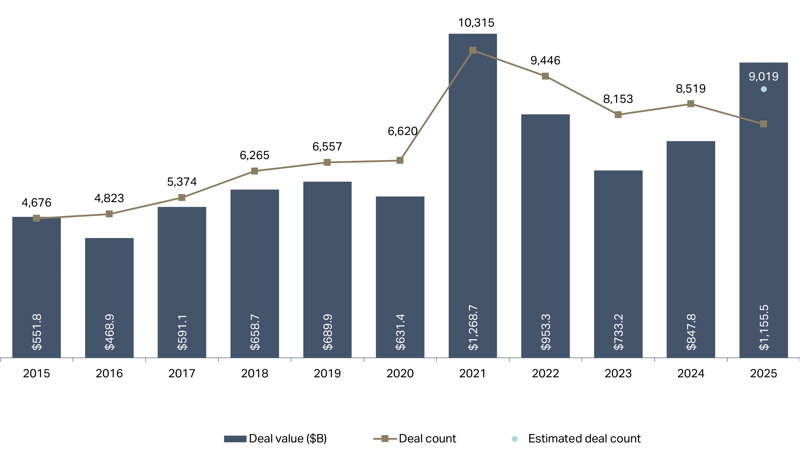

The takeaway for middle market owners is that capital is available, but sponsors and lenders are using it selectively. Well-positioned businesses with strong fundamentals continue to find deep buyer lists and competitive processes. Companies with more volatility in earnings or limited scale are facing more questions around structure, leverage, and valuation.
Valuation Metrics
U.S. Middle Market Private Equity - Volume Subdued, Valuations Firm
GF Data’s fourth quarter report, which tracks sponsor-backed transactions with enterprise values between $10 million and $500 million, paints a similar picture at the lower end of the market. For 2025, the data set captured 297 completed deals, down roughly 23% from 2024 and broadly consistent with 2023 activity. Q4 itself saw 84 reported transactions, modestly above the prior year but still well below peak volumes.
Despite softer volume, pricing held up. Across all 2025 transactions in the $10 to $500 million range, average purchase price multiples averaged about 7.2X trailing twelve month adjusted EBITDA, up from 6.9X in 2024 and the third highest annual level in the last twenty years, behind only 2021and 2022. Quarterly multiples were choppy, ranging from about 6.8 to 7.6X during the year, with Q4 landing around 6.9X.


The composition of deal types continued to evolve. Traditional buyouts accounted for roughly four-fifths of GF Data’s sample, down from prior years, while growth equity and recapitalizations represented a growing share of volume and, on average, commanded somewhat higher multiples. The “quality premium” for above average financial performers remained intact, with higher growth, higher margin companies trading at a meaningful premium to more average peers.
Sector Valuation Trends
Pricing diverged across industries. Manufacturing valuations softened slightly, with average multiples around 6.6X in 2025 compared with 7.0X in 2024, reflecting continued pressure in more cyclical and export-oriented niches. Business services multiples improved to roughly 7.4X in 2025 from 7.2X in the prior year, supported by strong demand for tech enabled and mission critical service models. Distribution held steady at approximately 6.9X on average, with specialty and value-added distributors generally faring better than more commodity-oriented models. Healthcare continued to command the highest ratings in the dataset at roughly 8.5X in 2025, up from 7.7X in 2024, as sponsors leaned into scaled platforms in devices, healthcare IT, and select services verticals.

The size premium also remained evident, though it narrowed somewhat compared with prior years. Companies in the $100 - $250 million TEV band continued to attract notably higher multiples than sub-$50 million businesses, signaling the value placed on scale, professionalization, and easier access to financing.

What It Means for Business Owners
The Window is Open, but Buyers are Discriminating
It would seem as if the market has settled into more of a steady state regarding tariff uncertainties, raising the optimism around 2026 deal activity. From True North’s own experience and market intelligence, quoting activity surrounding potential new deals in 2026 is significant, reflecting some of the pent-up supply from 2025. Buyers remain active and capital is plentiful, still favoring companies that can demonstrate consistent earnings, defensible margins, and a vivid growth thesis. Owners who bring a compelling, well-documented story to market can still achieve attractive outcomes. Those who do not may find that buyers focus more on structure than on price.
Preparation and Positioning are Key Differentiators
Deal timelines are still longer and diligence is deeper than in the last cycle. Buyers and lenders are scrutinizing revenue quality, margin sustainability, customer concentration, and working capital dynamics more closely. Sellers who invest early in clean financial reporting, thoughtful KPI dashboards, and a credible multi-year plan are better able to control the narrative and reduce friction in diligence. That preparation also creates more optionality, whether the outcome is a majority sale, a recapitalization with a growth partner, or a targeted acquisition agenda.
Looking Ahead
Barring a material macro shock, the backdrop for middle market M&A in early 2026 looks very positive. Valuations appear to have settled into a sustainable band and private equity demand remains strong. At the same time, policy uncertainty, tariff dynamics, and elevated but moderating interest rates mean buyers will diligence the exposure of each potential acquisition to these exposures.
For business owners, the message is straightforward. If your company has resilient cash flows, clear visibility into growth, and a management team that can articulate its value story, the coming year should offer a favorable window to explore strategic options, whether that is a sale, a recapitalization, or a thoughtful acquisition program. Starting the planning process early, with the right team around the table, remains the best way to turn today’s selective but healthy market into an advantage for your business.
November 13, 2025
LABCORP TO ACQUIRE SELECT PARKVIEW HEALTH LABORATORY OUTREACH ASSETS
BURLINGTON, N.C. and FORT WAYNE, Ind. — Labcorp (NYSE: LH), a global leader of innovative and comprehensive laboratory services, and Parkview Health, one of the fastest growing health systems in the Midwest, announced a strategic agreement for Labcorp to acquire select assets of the health system’s outreach laboratory services that provides high-quality testing across Indiana and northwest Ohio. Once finalized, the transaction is expected to enhance the patient and provider experience with continuity of convenient laboratory services while expanding access to Labcorp’s national network of patient service centers, comprehensive testing capabilities, advanced digital tools and actionable data-driven insights.
Source: Parkview Health
December 1, 2025
STEEL DYNAMICS COMPLETES ACQUISITION OF REMAINING 55% OWNERSHIP INTEREST IN NEW PROCESS STEEL
FORT WAYNE, Ind. — Steel Dynamics, Inc. (NASDAQ/GS: STLD) announced its completion of the acquisition of the remaining 55% equity interest in New Process Steel, L.P. New Process Steel is a metals solutions and distribution supply-chain management company headquartered in Houston, Texas, with a focus toward growing its value-added manufacturing applications. Steel Dynamics is a leading industrial metals solutions company, with facilities located throughout the United States, and in Mexico. The company operates using a circular manufacturing model, producing lower-carbon-emission, quality products with recycled scrap as the primary input. Steel Dynamics is one of the largest domestic steel producers and metal recyclers in North America.
Source: Steel Dynamics
October 14, 2025
KRIEG DEVAULT STRENGTHENS ITS INDIANA FOOTPRINT BY COMBINING WITH ROTHBERG LAW FIRM OF FORT WAYNE
Krieg DeVault announced that Rothberg Law Firm, a prominent Fort Wayne, Indiana law firm with 12 professionals, will become part of Krieg DeVault, effective January 1, 2026. The joining of the two firms will significantly strengthen Krieg DeVault’s Indiana presence and reputation as a premier Midwest firm. This combination marks the second by Krieg DeVault within the past year, following its combination with Fuchs & Roselli, Ltd., a 25-professional law firm in Chicago, in January 2025. Indianapolis-based Krieg DeVault is one of the largest law firms in Indiana, with additional offices in Carmel, Crown Point, and Mishawaka. Rothberg is an established Northeast Indiana firm with roots dating back to 1952.
Source: Krieg DeVault